I recall, from my early years, a Guinness Book of Records where a dinosaur had entered its pages with the record for having the smallest brain in proportion to its mass, so small (the size of a pea relative to ours) that the publication stated: “It was probably barely aware it was alive”. At an age when boys like to poke fun at others’ deficiencies, I found this hilarious. Calling someone “thick” was a cheap way to seem cleverer, and here was the ultimate. And when I heard an adult referring to someone as a “bird brain” I realised adults did this too.
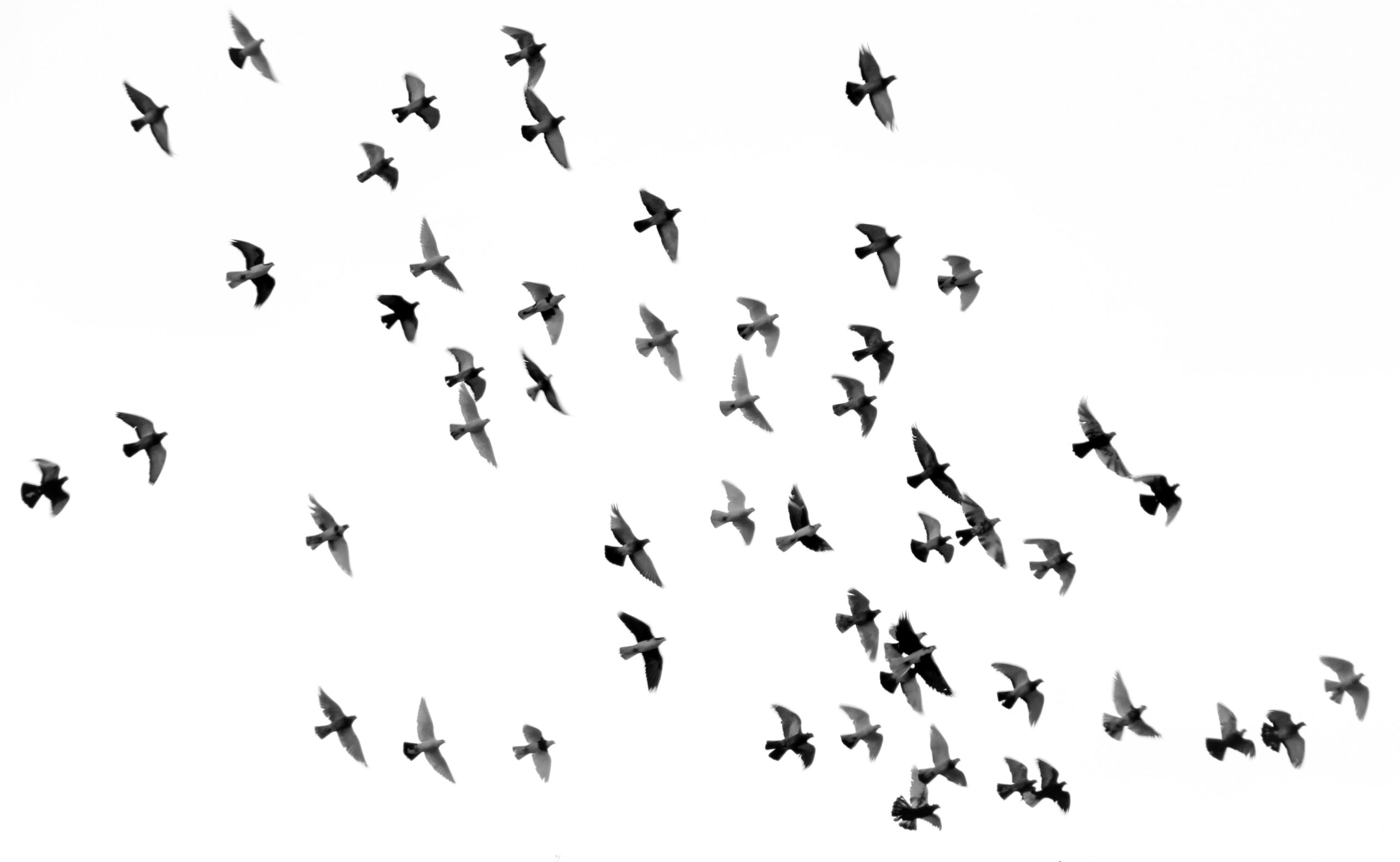
I wouldn’t mind being called a bird brain. Birds are simply astounding: they just know what to do, taking off without a dither as to where they are heading, shaping differing paths in flight, veering, swooping, barrel-rolling and gliding as and when they will. The air is theirs and, in the course of their daily life they use it well in other ways. Perhaps one percent of the birds in the world are fed by human hand; the rest use the surface which they look down upon to sustain them with both water and nourishment. “…they sow not,…nor do they gather into barns: yet your heavenly Father feeds them.” was Jesus’ observation, no need for supermarkets and drinking fountains to keep them alive.
Or duvets to keep them warm. Sustaining themselves may be easy compared with the vagaries of climate. Undoubtedly they have early warning systems in place but when harsh, sudden winds and cold sweep in and penetrate the body there are no shelters or heaters for them. Extra feathers aren’t even provided, but a fluffing, rearranging and careful angling of position must temper the storm and cold. And where the conditions are just not worth a gamble, fly they must and will, legendary distances by birds but a few grams in weight to a land where life can be lived and not just survived.
A mystery about birds: in the years I have been walking this planet, how many birds have I seen? Yet never have I come across a bird dead from old age. What happens to them? Do they slowly tumble off a branch to the ground where parasites rapidly consume them? Do they sense impending death and choose a private and dignified end where none sees them breathe their last?
By now a reader knows I am not a birder. Disqualifying me from those ranks is a lack of patience and a disposition to see only the irony of sitting in a “hide” when the birds are far better hidden. But I admire birders: that the Latin for a bird, avis, is almost identical to “avid” is not a coincidence: no other enthusiasm comes close to birders, some of whom, upon hearing of the sighting of a rare individual as yet unrecorded in his tally of sightings, will immediately board a plane from Johannesburg to Cape Town to photograph it. What goes with him will be, if there’s time, a change of clothing and, of course, a good camera to prove that the bird has been seen, correctly identified and, most importantly, added to his list.
There are two sides to what goes down in a list of birds. Firstly, there’s the important fact that species need be identified and differentiated so that the study of birds for scientific purposes can be advanced. Secondly, there is the compilation of a birdwatcher’s personal list on which are recorded all the different birds he or she has seen and identified, usually with some photographic evidence. To know how much interest and pleasure goes into identifying a bird might surprise it, but how happy would they be with these names?
Take one of the owls, for example. There’s a certain “owl-look” which makes them most distinct; some communities even fear owls and adopt certain superstitions around that baleful look. No other bird comes close to resembling it and yet the Eagle Owl has to put up with an unwelcome qualifier of its identity. It might be ornithologically correct, but that an owl, the epitome of a bird with self-respect, has to bear another bird’s name in its identity is a travesty.
Identifying the approximately 940 individual species of Southern African birds is a complicated task. Take the cuckoo-syndrome, for example, as seen with the Violet Widowfinch and the Brown Firefinch when fledglings of the latter are sometimes identified as Widowfinches of the violet description. Imagine the double indignation of the Firefinch: cuckooed by the Widowfinch and then its own fledglings confused by people who cannot not distinguish brown from violet.
Anyone who is a birder would have speedily and easily departed from the schoolboy understanding of “tit” and “booby”. But naming a bird a Rufous-bellied Tit may bring to mind the anatomical impossibility and the old joke. By being referred to as the Chestnut-vented Tit-babbler or the Chestnut-vented Warbler, another tit is being disserved . Considering the song of a bird is of essential importance to birders and bird alike, lumping a babble and a warble together suggests that some birders need a course in sound rather than bird identification.
Underlining the imperative of hearing the correct sound, we come to the Cisticola. A small, relatively inconspicuous bird, it makes a name for itself by raising the music bar: the Tinkling Cisticola, the Wailing Cisticola, the Rattling Cisticola, the Singing Cisticola and our percussionist, the Wing-snapping Cisticola are standing by ready to demonstrate. After that line-up, those who name birds decided that the Lazy Cisticola couldn’t be left that way: now it’s the Rock-loving Cisticola – perhaps in keeping with the music theme. A pity about the Zitting Cisticola, though, left as is, squeezing pimples.
Imagination is not, generally, useful when naming a bird. Exact observation and words which precisely describe the telling features are required so that the birder knows what he or she is looking for and, hopefully, at. Recently the Yellow-throated Leaflove became the Yellow-gorgeted Greenbul. Yes, it does require a visit to the dictionary, but upon discovering that a gorget is a piece of armour to protect the throat, the focus is perfectly honed: a small, central spot of yellow. That’s the easy part: to explain the loss of the delightful Leaflove means engaging with a journey across genera: first it was known as Haematornis (now obsolete as a genus), then Chlorocichla before becoming Atimastillas. Chances… “Not all authorities have adopted…” are it will move again, with three further genera popping up as candidates. The bird, fortunately, does not share in this confusion.
The Hudsonian Godwit has its definite name and uses that heaven-sent wit to good effect: extremely rare and shy, with which a close encounter is highly unlikely, it can only be identified if it takes off and reveals markings which shout: “Aah, the Hudsonian – not the Marbled or the Black-tailed Godwit!” But how long can you wait?
When a bird, owing to the force of wind and weather or another circumstance, makes landfall in Southern Africa, it is an event of note and worth a road trip or plane ride for a sighting. In 2006, on a farm near Williston in the Karoo, an Irania gutturalis remained alone for four days before it was seen no more. Also known as a Persian Robin, never has it been seen again in Southern Africa. The same, unfortunately, cannot be said for birds introduced: crows, mynas, starlings, sparrows and mallards are of this alien ilk which either threaten indigenous species or hybridise with them, such as the mallard has done with the yellow-billed duck. Had they been dealt with as did customs officials in 1964 with Chukar Partridges from the Middle East, Robben Island might have had one more bird on its list.
If identifying birds correctly is complicated, sighting anywhere near the total number of species in Southern Africa is an exercise in strategy. Step one is simple: take a leaf out of the book, 1000 places to visit before you die – start early and live long. Not only does it require good health and some disposable income, but patience, focus, both of camera and mind, and stamina. Out there are 22 petrels, 23 larks, not to mention the 25 Warblers, one of which bleats. But your bird listed Number One in the foundational Roberts’s Birds of Southern Africa won’t provide too much of a problem: the Ostrich.
Thanks to Mehdi Sepehri of Unsplash for the image


Lovely, “lightly” written informative essay about birds. Entices me to read more about birds and awakened my interest in even photographing them when and where the opportunity arises. Really enjoyed the read, content, context and style.
Thank you